Friends of Kevin · Cold Plunge Interviews · Guest
Alexander Farr
Co-founder & COO, Clera
LinkedIn · Clera In the plunge · 6 min
“Startup building is like the hardest thing you can do.”
Alex co-founded Clera, an AI talent agent and marketplace that matches candidates with startups. The week of the plunge, Clera launched fake-candidate detection.
Clips
Read the transcript
What's your name? What are you building? I'm Alex and I'm building Clera. Why are you building Clera? What is it? Clera is like a talent model plus a marketplace. So we build models predicting which candidate and company are going to be the best fit and then have a marketplace of 240,000 candidates and a couple hundred startups behind that, ultimately connecting them where we have our agents what the best fit. Where are you from? We're from Germany. Yeah. And we got started there. Actually, I have a pretty unique story. We moved to Latin America to work out of there, to be on the same time zone before we figured out the visa and the funding. Yeah. And then took us some time, raised here, got the visa and finally moved to SF. So tell me more about, is this your first company that you're building? It is, yeah. Yeah. So what was that moment that you told yourself that, hey, I need to build a company for myself? I mean, like I've been thinking about it for a long time. I'm like basically from high school and have been lucky to be in a program where there's been many unicorn founders in my close network, even people that I knew personally. So that was super inspiring and helping me figure out I could do the same and got me motivated to start that. And then I was the chief of staff for like a series A startup, was doing tons of recruiting and like growth there and just saw the pain point and got us to be super motivated to work on that and just like work hard on, you know, like solving the problem. I think you need to live in love. That's the space you're in. And what's the hardest thing building Clera? I think given that we have so many candidates and so many companies using us, it's like on the one hand super motivating, but also like anything we ship will be like used live within minutes. So there's a lot of responsibility and, you know, like making sure that we are actually able to serve everyone really well, especially in like the current difficult talent market. It's like a huge mission for us and we have like tons of product challenges to solve. Awesome. By the way, we've been talking for two minutes. How cold are you right now? Getting colder. Yeah. Is this harder than building a startup? Probably. Very easier. Yeah. So this is much easier than building a startup, right? Definitely. Startup building is like the hardest thing you can do. All you need is like stamina, like just like solving one challenge after the other. And this is like another nice challenge, I guess. Well, what's the lowest point for the, what's the lowest point for you building Clera? The lowest point for me? I think like in any fundraise, like most founders will just like tell you about like the success story and the amazing founders and that's just, they got on board. Same but like always, I think that's, you know, like just getting rejection emails all the time and no from investors is definitely like a time where you just need to like believe in your idea and like go through it. How hard is it fundraising for right now in this market? Like we raised recently, so I'm not sure about the current situation. Yeah. I mean, there's tons of amazing companies that are raising tons of money from amazing investors, but I think there's also a lot of founders that are struggling that you wouldn't hear about. So what's next for Clera? Are you guys launching? We actually have like four launch weeks. Like we just launched our fake candidate detection yesterday and basically helping flag candidates that might be fake. Maybe you've heard about like these. North Korean spies and candidates like that. So I launched that product and there's going to be three more products that we'll be launching in the next few weeks. So I guess follow us and you'll see which new features we'll offer to our companies and candidates. Why is that a problem? You mentioned that there's a lot of fake candidates that's happening. Why? Yeah. I mean, ultimately I think there's two reasons. On the one hand, there's some candidates that just don't get a job and so they're using like a better resume than they actually need. They have to be able to get the job and hopefully just stick around and, you know, like earn some salary. And there's also the story of one candidate that was working for seven YC companies at the same time, getting like paychecks for all of them. And then second, like this North Korea story is like, basically there was like a group of 22 spies that got more than a hundred thousand job interviews and I think like a couple of hundred offers. And they just like did like, basically a few naps to get a job. So it's like, you know, there's a lot of data from different companies on what they were working on. Have you ever, so are you, have you ever interview a fake candidate when you're burning Clera? Yes. Um, like I just interviewed him for our own engineering role and he was a bit, he had to me like throw out the call and then I like confronted him and asked him, could I like email an email to like your current company email? And then he just left the call, didn't say anything. So that was a clear fake. So if the company isn't using Clera, like how can they figure out the interview that the candidate is actually a fake candidate? I think there's some signals that commonly you would see it on a resume that, you know, maybe, okay, let me, let me rephrase that. It's typically quite hard if you don't have enough data, because what we see is that candidates between different companies and their different ATS might be the same. And even using the same phone number across different resumes, which is like an immediate red flag. But if you're only one company and they see the grid, it can be hard. Many companies enforce like in-person interviews so that they can overcome this. But often for like remote roles, this is hard to achieve. And what was next for Clera? Um, ultimately just building like a bigger company than LinkedIn and, you know, like getting from like 200,000 candidates to more than a million candidates using us and similarly hundreds of companies using us and hiring through us.
More interviews

Memo
CTO, Open LLM
For Tech Week we came and for TechCrunch we stayed.
In the plunge · 5 min 20 s
Frank Sondors
Co-founder & CEO, Salesforge
Here, literally every day, you can go to like two to five events and then you can engineer luck.
In the plunge · 4 min 20 s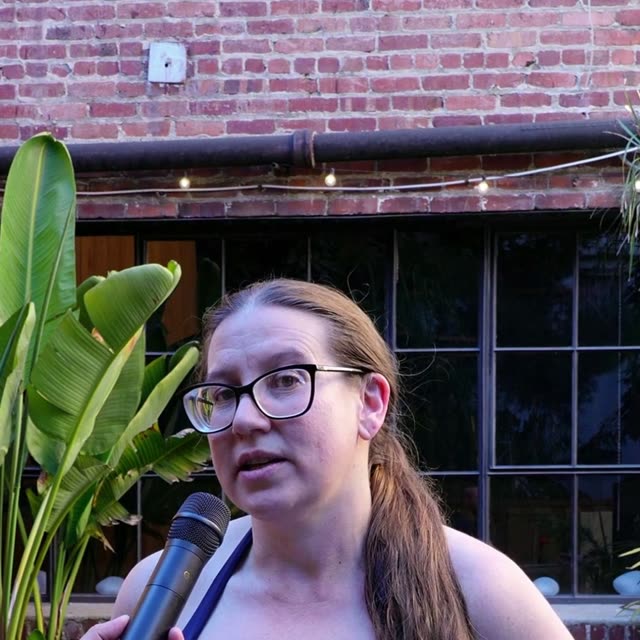
Rachel Flanagan
Voice-restoration medtech
Think of all the times you speak in a day.
In the plunge · 4 min